


A plain-English guide to building, using and protecting credit — with the myths removed.
There’s a loop almost everyone runs into at the start: you can’t get approved for credit without a credit history, and you can’t build a credit history without getting approved for something. It’s a real trap, and most advice about escaping it is either too vague to act on or wrong in a way that costs money.
This guide answers the nine questions people actually ask — the ones typed into a search bar at one in the morning, not the ones a bank would prefer you asked. Each answer is short and complete. Where there’s more worth knowing, we’ve linked the full breakdown.
Start wherever you are: building from nothing, using a card you already have, or protecting a score you’ve worked for.
First, what a credit score actually measures
Every answer below traces back to these five factors. Most bad credit advice is someone over-weighting one of the small ones.
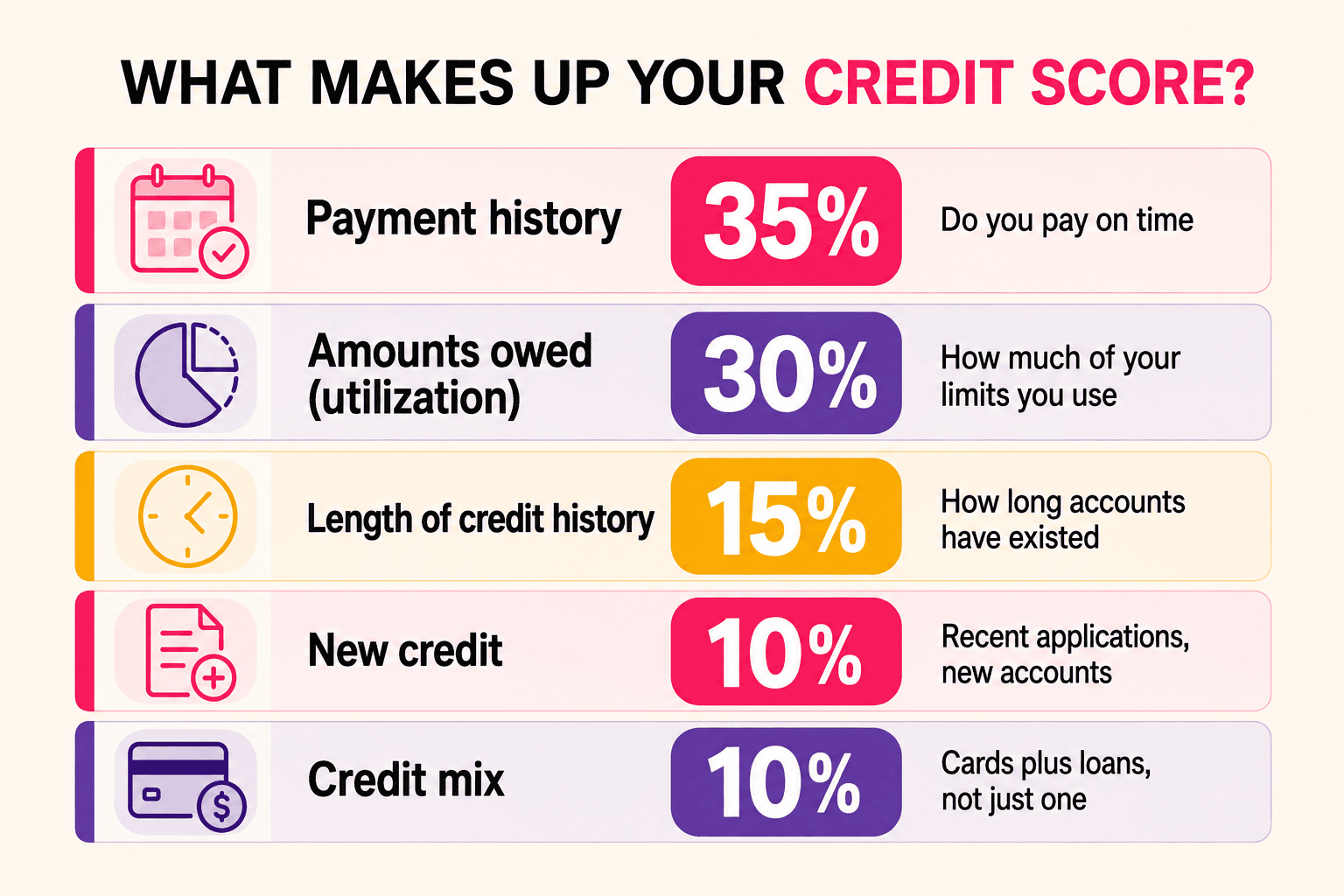
Two things follow. Payment history and utilization together are 65% of your score, so that’s where effort actually pays. And credit mix — the reason people get talked into loans they don’t need — is 10%.
Part 1 · Building from zero
1. What’s the fastest way to build credit from scratch with no score?
Short answer: six months, minimum — so the fastest thing you can do is start today.
FICO needs at least six months of reported history on at least one account before it can generate a score at all. VantageScore, which many free credit apps use, can produce one in about a month. There’s no way to shortcut that clock. There’s only starting it earlier.
Ranked by how quickly they get history onto your file:
- Becoming an authorized user on someone else’s established account — this can appear on your file within one billing cycle.
- Opening a secured card and putting one small recurring charge on it — slower, but the account is entirely yours.
- Getting credit for large payments you already make every month, such as rent.
What doesn’t work: paying cash for everything (invisible to the bureaus), checking your own score repeatedly (a soft pull, no effect either way), or any service promising a specific number by a specific date.
2. Should I get a secured credit card or become an authorized user?
Short answer: they aren’t competitors. Authorized user for speed, secured card for ownership — do both if you can.
Becoming an authorized user is fast and usually free. You can inherit years of someone else’s payment history within a cycle. Three catches: not every issuer reports authorized users to the bureaus, some lenders discount authorized-user accounts when they review an application manually, and the primary cardholder’s missed payment or maxed-out balance lands on your report too.
A secured card is slower but it’s yours. You put down a refundable deposit, usually $200 to $500, control every input, and most cards graduate to unsecured after a year of on-time payments. No lender discounts it.
Before you accept an authorized-user spot, ask three questions: Does the issuer report authorized users to the bureaus? Is the account at least two years old with a perfect payment history? Do they keep their utilization under about 10%? If any answer is no, the spot may do nothing — or actively hurt.
3. Will a small personal loan help my score more than a credit card?
Short answer: no. Credit mix is 10% of your score, and a loan isn’t free.
The pitch is that lenders like to see both revolving credit (cards) and installment credit (loans). That’s true, and it’s 10% of the calculation. A personal loan taken purely to move that 10% costs you a hard inquiry, often a 1–8% origination fee, and interest for the life of the loan. A credit card paid in full every month costs nothing.
The one legitimate exception is a credit-builder loan, where your payments go into a locked savings account and you receive the money at the end. That’s a savings product structured as a loan, and for a genuinely thin file it can make sense.
The rule: if you’d take the loan anyway, fine. Never borrow money you don’t need in order to improve a number.
Part 2 · Using credit right
4. Should I pay off my card immediately or wait for the statement?
Short answer: two dates matter, and they do different jobs.
Most issuers report your statement closing balance to the bureaus — not your balance on the due date. So the number that becomes your utilization is whatever sits on the card the day your statement closes.
That gives you two levers. Paying the full statement balance by the due date keeps you inside the grace period, so you owe no interest. Paying the balance down before the statement closes lowers the number that gets reported. If you put a large charge on the card this cycle, pay it down before close and it never shows up on your credit file at all.
One nuance worth knowing: reporting $0 across every card can score slightly lower than reporting a small balance on one. The clean pattern is to let a small balance post, then pay the statement in full.
5. What percentage of my credit limit should I actually use?
Short answer: under 30% is the guardrail. The people with the best scores sit far below it.
Thirty percent is the line where damage starts, not the line where good scores live. Consumers with the highest scores typically report utilization in the low single digits.
Two things people miss. First, per-card and total utilization are both scored, so one maxed-out card can hurt even when your overall number looks fine. Second, utilization has no memory — it’s a snapshot from your latest statement, not a running average, so a bad month is repaired by the next statement.
That second point matters more than it sounds. You don’t have to spend less; you have to report less. Pay before the statement closes, request a limit increase, or split charges across cards.
6. Does carrying a small balance build credit faster than paying in full?
Short answer: no — and it’s the most expensive myth in personal finance.
Utilization is a snapshot of what you owe. It carries no record of whether you paid interest, and there is no field on your credit report for it. Your issuer reports the account as “paid as agreed” whether you cleared the statement or carried it. The scoring model cannot tell the difference. Your bank account can.
The myth survives because it garbles something true. Using the card does matter — a dormant account gives the bureaus nothing to report. Carrying a balance is a different thing entirely, and it just means paying interest for no scoring benefit.
The correct pattern is boring: use the card, let the statement post, pay it in full by the due date.
A note on the payments you already make
Everything above assumes credit is something you open. It doesn’t have to be. Payment history is the largest single factor in your score, and several payments you already make each month can be added to your file:
- Utilities and streaming subscriptions can be added to your Experian file directly through Experian Boost.
- Rent is usually the biggest one. Piñata reports verified on-time rent payments to Experian, Equifax and TransUnion, and some renters qualify to have past payments back-reported.
- Credit-builder loans, covered above, report an installment account without putting you into real debt.
None of these replace a credit card, and how much they help depends on which scoring model a lender uses — newer models weigh rental data more heavily than some older versions still common in mortgage lending. But they add positive payment history without a hard inquiry, a deposit, or new debt, which makes them worth doing alongside everything else rather than instead of it.
Part 3 · Protecting what you’ve built
7. How badly will my score drop if I apply for several cards at once?
Short answer: one inquiry costs about five points or fewer. Several at once is a different problem.
A single hard inquiry typically knocks off five points or fewer, and the effect fades within a few months. Inquiries stay visible on your report for two years but only factor into your FICO score for twelve.
The compounding risk is where people get caught. Several applications in a short window read as risk to a lender, and every new account you open drags down your average account age — which matters most on a thin file, exactly the file most likely to be shopping around.
One more thing worth knowing: rate-shopping protection, where multiple inquiries inside a 14 to 30 day window count as one, applies to mortgages, auto loans and student loans. It does not apply to credit cards.
Practical rule: space card applications three to six months apart, and use prequalification — a soft pull — before you formally apply.
8. Does closing an old, unused credit card hurt my credit age and score?
Short answer: yes, but not for the reason most people think.
Closing a card doesn’t erase it. Closed accounts in good standing typically stay on your report for about ten years, and they keep counting toward your length of credit history that entire time. Your credit age does not drop the day you close it.
The immediate damage is utilization. That card’s limit disappears from your total available credit, so the same spending on your other cards suddenly represents a higher percentage. That happens overnight.
The delayed damage arrives in roughly ten years, when the account finally falls off your report and your average account age drops with it.
Better moves: keep it open with one small recurring charge on autopay, so the issuer doesn’t close it for inactivity. If it carries an annual fee, ask to downgrade to the issuer’s no-fee version of the same card — a product change keeps the original account and its open date intact.
Closing is genuinely the right call when the fee outweighs the value and no downgrade is offered, or when the card enables spending you can’t control. Your finances outrank your score.
9. What is the impact of a late payment on my credit score?
Short answer: nothing, until you’re 30 days past due. After that, it stays for seven years.
This is the most useful thing on this page. Lenders do not report a missed payment to the bureaus until it is 30 days past due. Between the due date and day 30 you’ll owe a late fee and may lose a promotional APR, but your credit file is untouched. If you’ve just realised you missed a payment, you probably still have time.
Once it is reported, it stays on your credit report for seven years. Payment history is 35% of your score — the largest single factor — and a first late payment usually costs someone with a strong score more points than someone whose file is already damaged, simply because there’s more to lose.
It escalates from there: 30 days, 60, 90, 120 or more, then charge-off and collections. Each rung is meaningfully worse than the last.
If it’s already been reported: pay it immediately, set up autopay for at least the minimum so it can’t happen again, and if it was a genuine one-off on an otherwise clean account, write to the issuer and ask for a goodwill adjustment. They aren’t obliged to remove it, but they sometimes do.
The short version
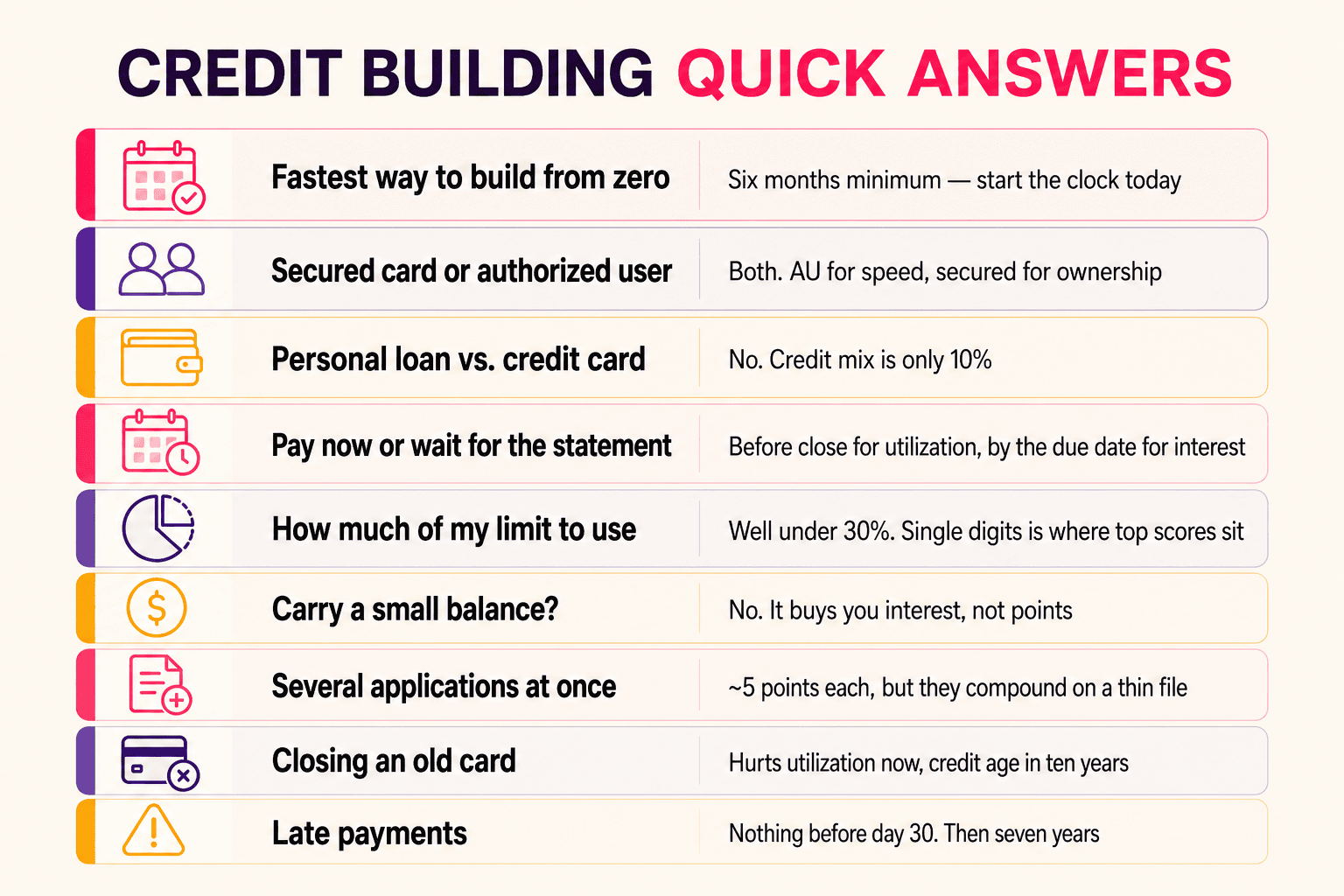
Wherever you start from here, one step doesn’t require opening anything: if you rent, that payment can count. Piñata reports verified on-time rent to Experian, Equifax and TransUnion, and some renters qualify to have past payments back-reported. It replaces nothing on this page — it just stops the largest payment you make from counting for nothing.
Learn more about Piñata: pinata.ai
Sources:
myFICO — What’s in Your FICO Score
Experian — How Many Points Does an Inquiry Drop Your Credit Score?
Experian — Can One 30-Day Late Payment Hurt Your Credit?
TransUnion — How Long Do Late Payments Stay on Your Credit Report?